
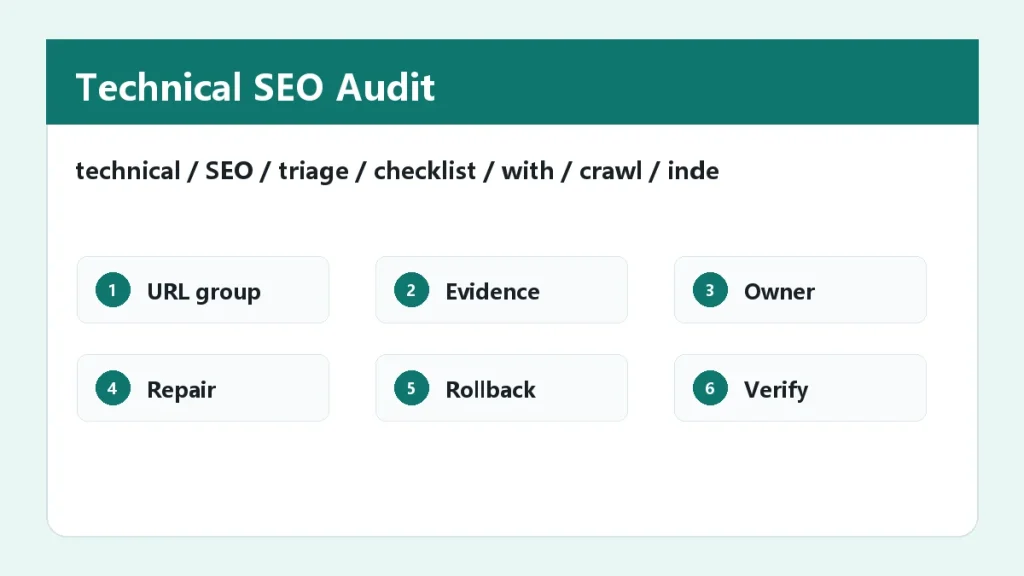
technical SEO triage checklist should not start from a single tool score. The useful workflow keeps URL groups, evidence, owners, repair scope, rollback, and verification in one record.
This English guide keeps diagnosis, release action, and verification separate so the team does not confuse a tool observation with a completed result.
Quick Answer: Prioritize Technical SEO by Evidence and Impact
technical SEO triage checklist starts with exact URLs, status evidence, canonical signals, rendered output, owner assignment, and a release-safe verification plan.
Basic Facts for Technical SEO Triage
| Crawl step | URL group evidence |
|---|---|
| Index method | source and rendered output |
| Rendering tool | named owner |
| Canonical record | smallest reversible repair |
| Template mistake | rollback cue |
| Cache-bust verification | ordinary/cache-bust window |
Step 1: Separate Crawl, Index, and Rendering Signals
Step 1: Separate Crawl, Index, and Rendering Signals begins with a URL group, not a single tool score. For technical SEO triage checklist, record the URL, status code, canonical result, rendered DOM, owner, and business impact before proposing a repair.
Step 1 should preserve raw evidence and a repeatable verification method. Ordinary URLs, cache-bust URLs, desktop output, mobile output, and log samples need separate notes.
If the evidence shows only a page-level exception, do not expand the fix into a template change. The recommendation must state the smallest action, rollback condition, and acceptance test.
The output of technical SEO triage checklist is an execution queue: issue, evidence, owner, scope, release action, verification time, and final conclusion.
Business impact should be written in observable terms, such as inaccessible pages, conflicting index signals, duplicate content, visible template leakage, or mobile layout failure. A vague severity label is not enough for scheduling.
Each repair item needs before-and-after evidence. Source HTML, rendered DOM, HTTP status, canonical tags, sitemap behavior, and screenshots should be recorded separately.
When evidence is incomplete, keep the item as evidence pending instead of turning it into a broad site incident. That protects the release queue from overreach while preserving the real risk.
The final judgment should be easy for another reviewer to repeat. Owner, check time, rollback cue, and next observation window belong in the same record.
A practical team record should also name the source of truth. Search Console, server logs, crawler output, CMS fields, and rendered browser evidence often describe different layers of the same problem.
The repair queue should keep those layers visible. That makes it easier to decide whether the next action belongs to content editing, internal links, template output, redirect rules, sitemap refresh, or observation.
For larger sites, group the work by pattern before touching individual pages. A small sample can show whether the issue repeats across a template, a category, a language version, or only one old URL.
For smaller sites, the same discipline still matters. A single page can create misleading signals when canonical tags, sitemap entries, body copy, and rendered layout are reviewed in separate tools.
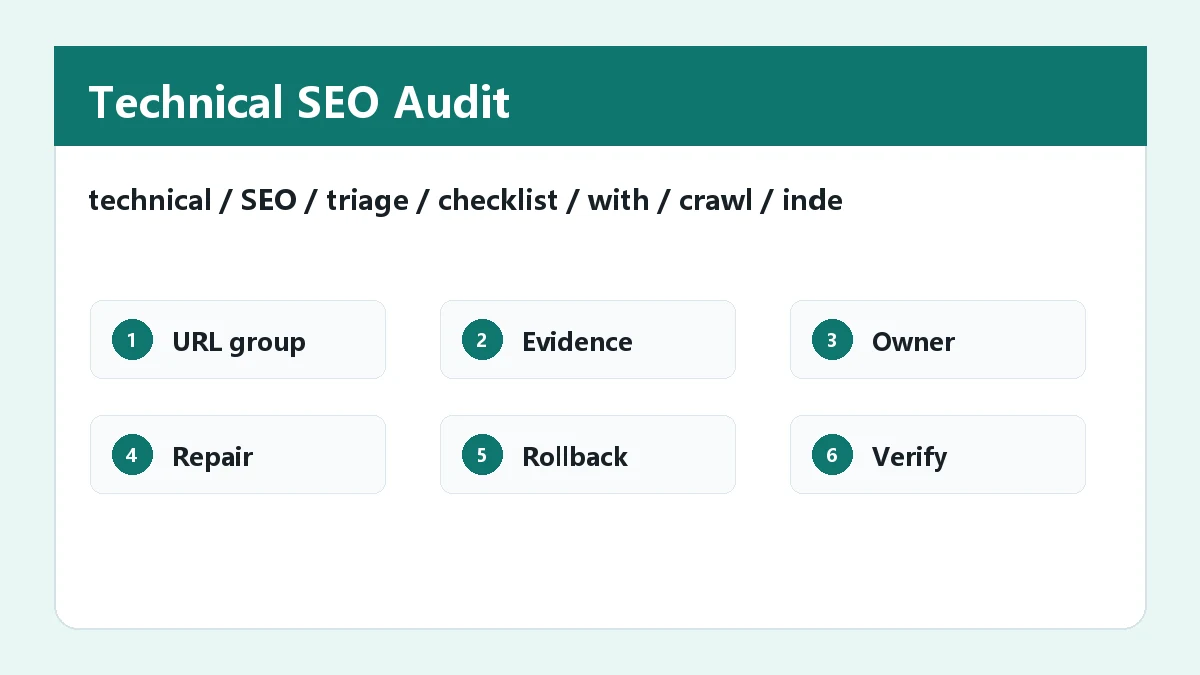
Step 2: Check Canonical, Sitemap, and Internal Link Conflicts
Step 2: Check Canonical, Sitemap, and Internal Link Conflicts begins with a URL group, not a single tool score. For technical SEO triage checklist, record the URL, status code, canonical result, rendered DOM, owner, and business impact before proposing a repair.
Step 2 should preserve raw evidence and a repeatable verification method. Ordinary URLs, cache-bust URLs, desktop output, mobile output, and log samples need separate notes.
If the evidence shows only a page-level exception, do not expand the fix into a template change. The recommendation must state the smallest action, rollback condition, and acceptance test.
The output of technical SEO triage checklist is an execution queue: issue, evidence, owner, scope, release action, verification time, and final conclusion.
Business impact should be written in observable terms, such as inaccessible pages, conflicting index signals, duplicate content, visible template leakage, or mobile layout failure. A vague severity label is not enough for scheduling.
Each repair item needs before-and-after evidence. Source HTML, rendered DOM, HTTP status, canonical tags, sitemap behavior, and screenshots should be recorded separately.
When evidence is incomplete, keep the item as evidence pending instead of turning it into a broad site incident. That protects the release queue from overreach while preserving the real risk.
The final judgment should be easy for another reviewer to repeat. Owner, check time, rollback cue, and next observation window belong in the same record.
A practical team record should also name the source of truth. Search Console, server logs, crawler output, CMS fields, and rendered browser evidence often describe different layers of the same problem.
The repair queue should keep those layers visible. That makes it easier to decide whether the next action belongs to content editing, internal links, template output, redirect rules, sitemap refresh, or observation.
For larger sites, group the work by pattern before touching individual pages. A small sample can show whether the issue repeats across a template, a category, a language version, or only one old URL.
For smaller sites, the same discipline still matters. A single page can create misleading signals when canonical tags, sitemap entries, body copy, and rendered layout are reviewed in separate tools.
Step 3: Identify Template-Level Versus Single-Page Issues
Step 3: Identify Template-Level Versus Single-Page Issues begins with a URL group, not a single tool score. For technical SEO triage checklist, record the URL, status code, canonical result, rendered DOM, owner, and business impact before proposing a repair.
Step 3 should preserve raw evidence and a repeatable verification method. Ordinary URLs, cache-bust URLs, desktop output, mobile output, and log samples need separate notes.
If the evidence shows only a page-level exception, do not expand the fix into a template change. The recommendation must state the smallest action, rollback condition, and acceptance test.
The output of technical SEO triage checklist is an execution queue: issue, evidence, owner, scope, release action, verification time, and final conclusion.
Business impact should be written in observable terms, such as inaccessible pages, conflicting index signals, duplicate content, visible template leakage, or mobile layout failure. A vague severity label is not enough for scheduling.
Each repair item needs before-and-after evidence. Source HTML, rendered DOM, HTTP status, canonical tags, sitemap behavior, and screenshots should be recorded separately.
When evidence is incomplete, keep the item as evidence pending instead of turning it into a broad site incident. That protects the release queue from overreach while preserving the real risk.
The final judgment should be easy for another reviewer to repeat. Owner, check time, rollback cue, and next observation window belong in the same record.
A practical team record should also name the source of truth. Search Console, server logs, crawler output, CMS fields, and rendered browser evidence often describe different layers of the same problem.
The repair queue should keep those layers visible. That makes it easier to decide whether the next action belongs to content editing, internal links, template output, redirect rules, sitemap refresh, or observation.
For larger sites, group the work by pattern before touching individual pages. A small sample can show whether the issue repeats across a template, a category, a language version, or only one old URL.
For smaller sites, the same discipline still matters. A single page can create misleading signals when canonical tags, sitemap entries, body copy, and rendered layout are reviewed in separate tools.
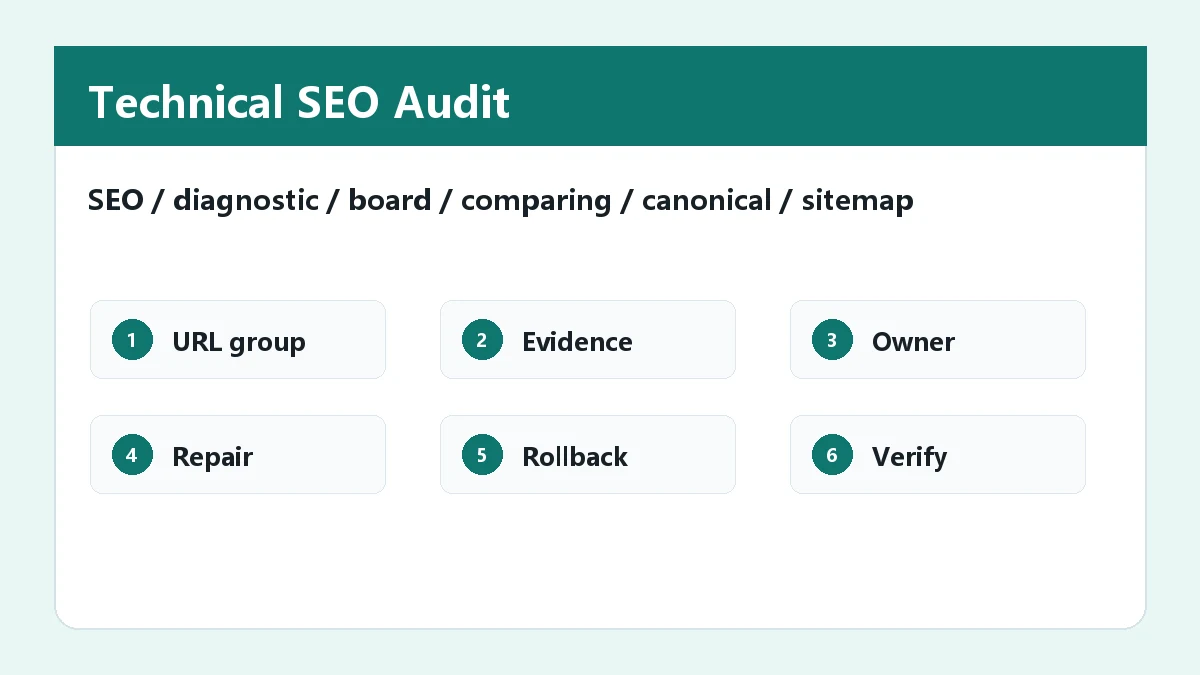
Step 4: Record Owner, Release Scope, and Verification Window
Step 4: Record Owner, Release Scope, and Verification Window begins with a URL group, not a single tool score. For technical SEO triage checklist, record the URL, status code, canonical result, rendered DOM, owner, and business impact before proposing a repair.
Step 4 should preserve raw evidence and a repeatable verification method. Ordinary URLs, cache-bust URLs, desktop output, mobile output, and log samples need separate notes.
If the evidence shows only a page-level exception, do not expand the fix into a template change. The recommendation must state the smallest action, rollback condition, and acceptance test.
The output of technical SEO triage checklist is an execution queue: issue, evidence, owner, scope, release action, verification time, and final conclusion.
Business impact should be written in observable terms, such as inaccessible pages, conflicting index signals, duplicate content, visible template leakage, or mobile layout failure. A vague severity label is not enough for scheduling.
Each repair item needs before-and-after evidence. Source HTML, rendered DOM, HTTP status, canonical tags, sitemap behavior, and screenshots should be recorded separately.
When evidence is incomplete, keep the item as evidence pending instead of turning it into a broad site incident. That protects the release queue from overreach while preserving the real risk.
The final judgment should be easy for another reviewer to repeat. Owner, check time, rollback cue, and next observation window belong in the same record.
A practical team record should also name the source of truth. Search Console, server logs, crawler output, CMS fields, and rendered browser evidence often describe different layers of the same problem.
The repair queue should keep those layers visible. That makes it easier to decide whether the next action belongs to content editing, internal links, template output, redirect rules, sitemap refresh, or observation.
For larger sites, group the work by pattern before touching individual pages. A small sample can show whether the issue repeats across a template, a category, a language version, or only one old URL.
For smaller sites, the same discipline still matters. A single page can create misleading signals when canonical tags, sitemap entries, body copy, and rendered layout are reviewed in separate tools.
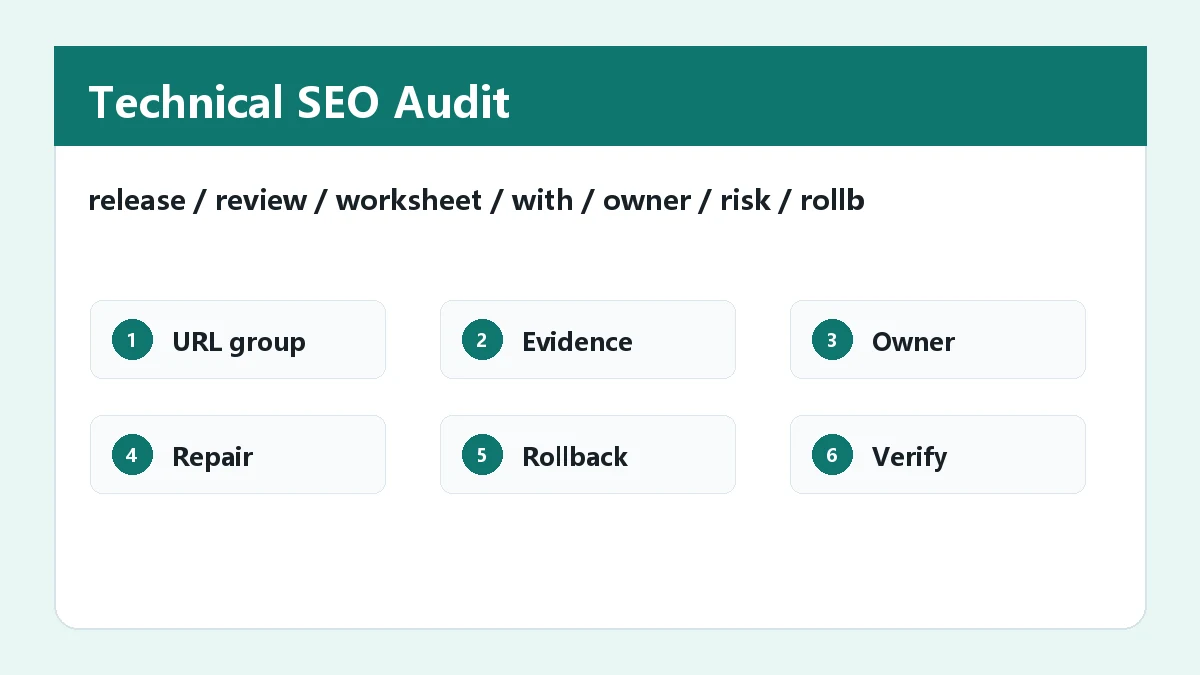
Quick reference: Technical SEO Triage Fields
technical SEO triage checklist reference: preserve the URL group, evidence source, owner, repair action, rollback boundary, and verification result before reporting closure.
- https://www.seoguan.com/blog
- https://www.seoguan.com/tools/seo audit
- https://www.seoguan.com/services
- External reference
Frequently Asked Questions
What is the first step in technical SEO triage checklist?
What is the first step in technical SEO triage checklist? The answer must stay evidence-bounded for technical SEO triage checklist and must not promise rankings, traffic, or migration results.
Which evidence is required for technical SEO triage checklist?
Which evidence is required for technical SEO triage checklist? The answer must stay evidence-bounded for technical SEO triage checklist and must not promise rankings, traffic, or migration results.
Can technical SEO triage checklist guarantee rankings?
Can technical SEO triage checklist guarantee rankings? The answer must stay evidence-bounded for technical SEO triage checklist and must not promise rankings, traffic, or migration results.
How should technical SEO triage checklist be verified after release?
How should technical SEO triage checklist be verified after release? The answer must stay evidence-bounded for technical SEO triage checklist and must not promise rankings, traffic, or migration results.
